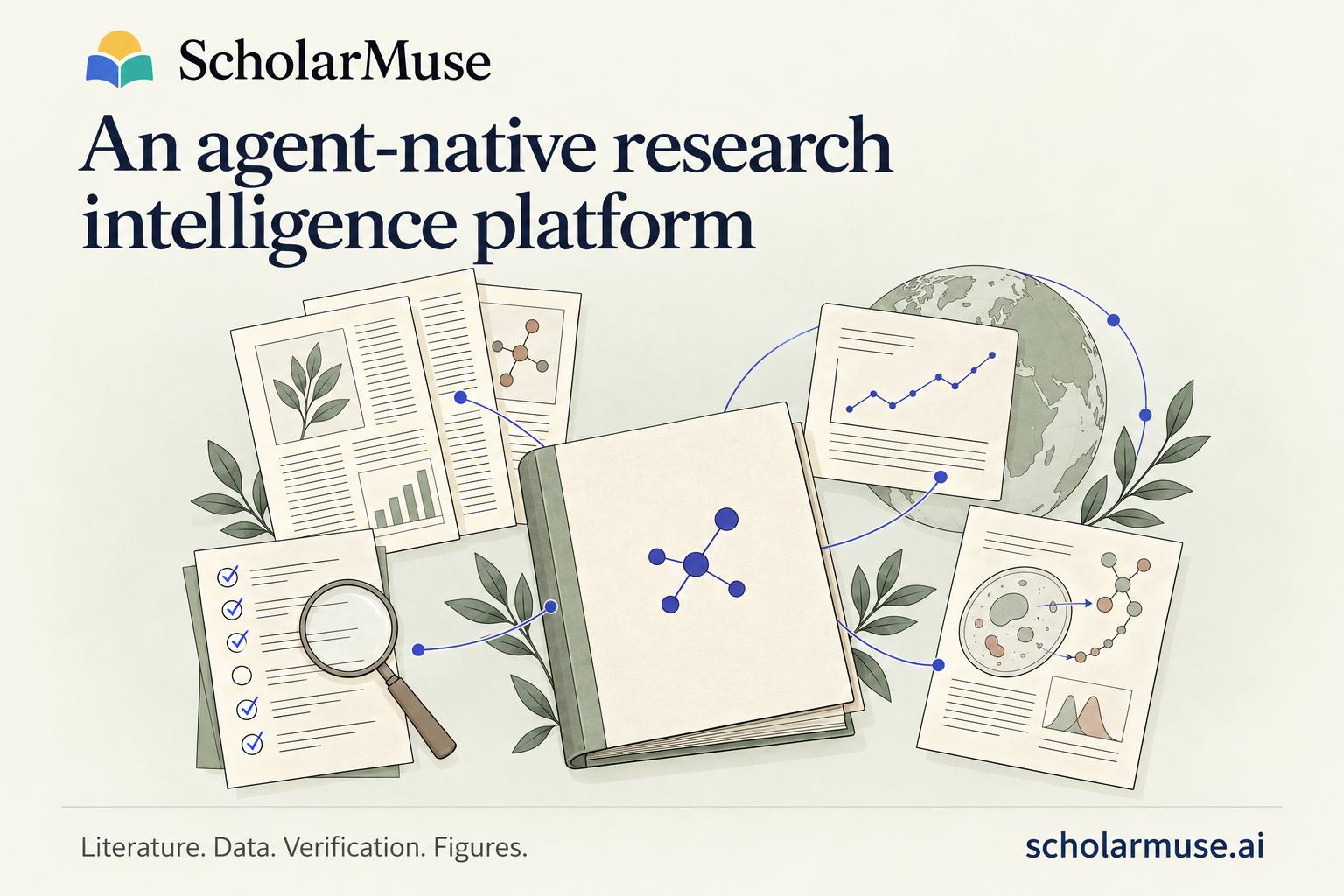
Connecting scholarly literature, scientific data, reference verification and figure generation within existing AI agent workflows.
NEWARK, DE, UNITED STATES, October 16, 2026 /EINPresswire.com/ — ScholarMuse introduces an agent-native research intelligence platform that connects existing AI agents with scholarly literature, scientific data, reference verification and scientific figure generation. Through a unified tool interface, researchers can bring specialized research capabilities into the AI environments they already use, with structured source records that support inspection and further analysis.
The platform addresses a practical challenge in AI-assisted research: language models can help formulate questions and organize information, while research tasks also require access to external records, disciplinary databases and verifiable references. ScholarMuse provides a research intelligence layer between compatible agents and more than 50 research data sources, connecting conversational work with tools for retrieving and checking information.
Research capabilities inside existing agent workflows
ScholarMuse makes its tools available through the Model Context Protocol, or MCP, and a REST API. Compatible clients include Claude, ChatGPT, Codex and Cursor, with connection requirements depending on the client. Researchers can use natural-language requests to direct their connected agent, while developers can integrate the same research tools into scripts and applications through the API.
The agent coordinates the task; ScholarMuse supplies the specialized tool calls. A literature review, for example, can involve searching for relevant publications, retrieving individual paper records, checking a draft bibliography and finding related datasets. These activities can be requested within an existing agent workflow, with the researcher reviewing the returned material as the work develops.
A unified interface across research disciplines
The platform’s research capabilities cover literature discovery, reference checking, research funding, datasets, statistics and scientific illustration, alongside specialized tools for life sciences, chemistry, materials, environmental research, astronomy and humanities.
Literature integrations draw on sources including OpenAlex, Crossref and arXiv, with PubMed-indexed records accessed through Europe PMC. Funding searches cover projects recorded by NIH RePORTER, NSF Awards and UKRI. Dataset discovery spans repositories and indexes including DataCite, Zenodo, Dryad and Harvard Dataverse, while economic and social statistics tools support sources such as FRED and the World Bank.
Discipline-specific capabilities extend the workflow to gene and protein records, molecular and protein structures, clinical trials, compounds, historical weather, earthquakes, species observations and astronomical records. Each tool exposes a defined set of queries and fields, allowing researchers to select capabilities appropriate to the question and the available source coverage.
Traceable records and reference verification
Retrieved records retain source identifiers and retrieval timestamps, together with original-record links, licensing and attribution information where applicable. This structure helps researchers inspect where a result came from and return to the underlying record when preparing analysis, documentation or citations. Multi-source tools identify partial results and report sources that could not respond.
The citation checker compares submitted references with bibliographic records to identify matches, discrepancies and entries requiring further review. A separate retraction-checking tool examines available notices and status information for retractions, corrections and expressions of concern. These checks support editorial and research review; their coverage depends on the records available from the underlying sources.
Scientific communication within the same working context
ScholarMuse also provides tools for generating and revising scientific illustrations, including mechanism diagrams, pathways, study designs, workflows and graphical abstracts. Researchers can request a figure from a description and direct subsequent revisions through their connected agent. Generated illustrations require scientific review before use; the figure tools are separate from the retrieval of source-backed research records.
The website also offers browser-based entry points for citation and retraction checks, journal queries, NIH project searches, dataset discovery and graphical abstracts. Free browser tools and data-query credits are available within published limits. Scientific figure generation requires a paid plan or credit pack, with current terms available on the website.
ScholarMuse is available at scholarmuse.ai. Connection instructions, capability descriptions and source documentation explain how to configure supported clients and what each tool returns.
About ScholarMuse
ScholarMuse is an agent-native research intelligence platform providing academic data access, reference verification and scientific illustration tools through MCP and REST API. It connects compatible AI agents with multidisciplinary research sources and structured results designed for inspection and reuse.
Davie Chen
TopLocalAI, LLC
davie@daviechen.com
Legal Disclaimer:
EIN Presswire provides this news content “as is” without warranty of any kind. We do not accept any responsibility or liability
for the accuracy, content, images, videos, licenses, completeness, legality, or reliability of the information contained in this
article. If you have any complaints or copyright issues related to this article, kindly contact the author above.

Media gallery