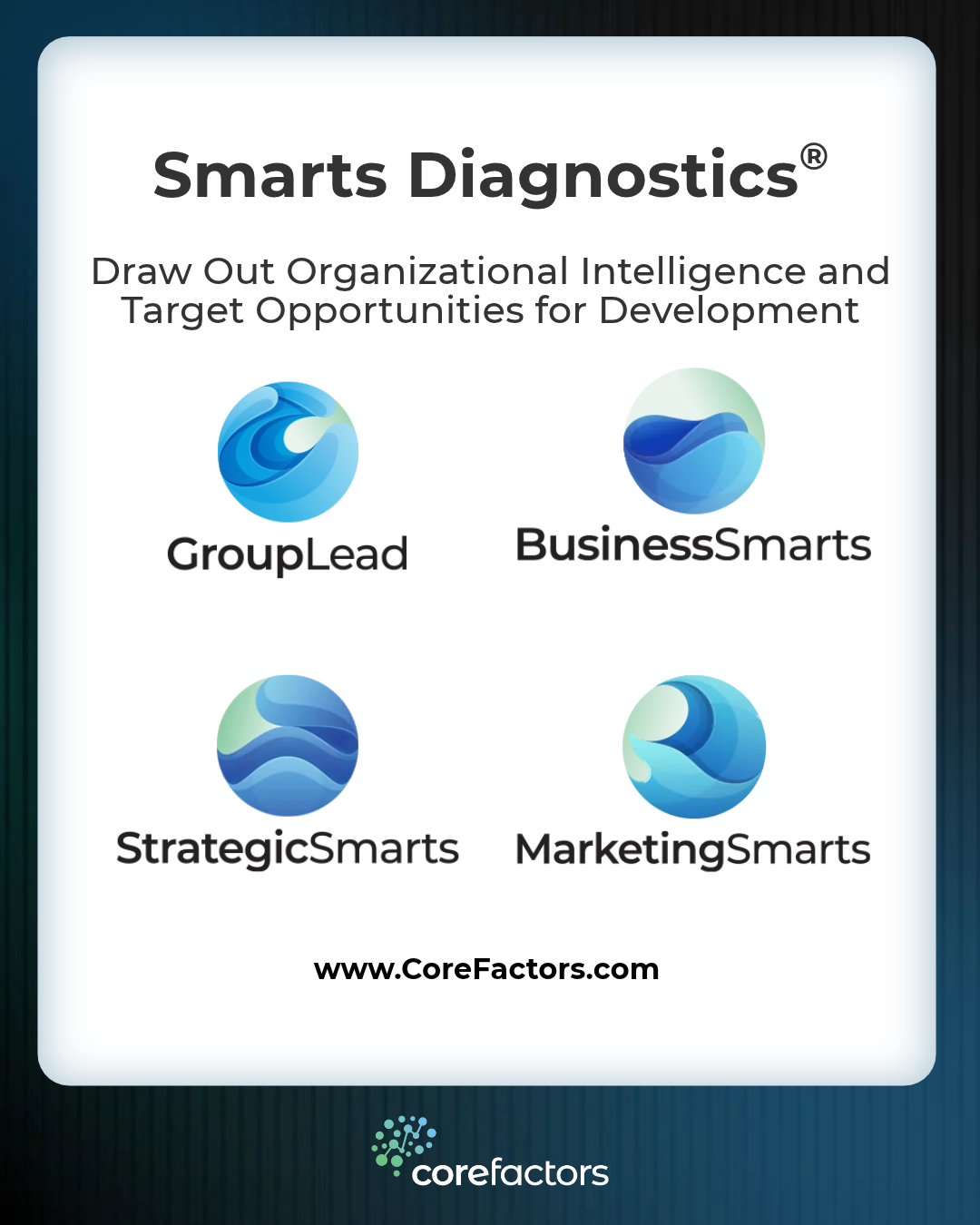

Core Factors releases Smarts Diagnostics: one team diagnostic and three organizational diagnostics that identify strengths and areas of needed focus.
TEMECULA, CA, UNITED STATES, November 24, 2026 /EINPresswire.com/ — Core Factors, a people-development platform for coaches, consultants, and HR professionals, today released Smarts Diagnostics®. Smarts Diagnostics are one team diagnostic and three organizational diagnostics that identify strengths and areas of needed focus. Group Lead™ is a team effectiveness diagnostic for one team, and Business Smarts, Strategic Smarts, and Marketing Smarts are organizational diagnostics of business performance, strategy execution, and marketing performance. Roger R. Pearman, Ed.D., who developed the EQ Accelerator® and the Brain Agility Lens™, developed all four diagnostics. In each diagnostic, the people inside the team or the organization rate how often specific behaviors occur, and the results compare those ratings with a benchmark. Executive coaches, team coaches, OD consultants, and leadership and HR consulting firms can use the results to direct a client’s development investment toward the priorities that affect performance. The people who work in a team or an organization hold the perspectives that explain performance, and each diagnostic draws out that organizational intelligence in one set of results. The release extends the Core Factors platform from the development of individuals to the development of teams and organizations, and practitioners administer every diagnostic through a free Pro Account.
Smarts Diagnostics from Core Factors consist of one team diagnostic, Group Lead, and three organizational diagnostics: Business Smarts, Strategic Smarts, and Marketing Smarts. Each person completes a diagnostic in about 15 minutes, every individual response stays anonymous, and practitioners administer every diagnostic through a free Core Factors Pro Account.
Group Lead is a team effectiveness diagnostic in which a minimum of five Team Members rate 75 team behaviors in fifteen dimensions, and the results benchmark the team against highly effective teams. Business Smarts is a business performance diagnostic in which a minimum of 15 raters rate 45 leadership behaviors in nine areas of the business. Strategic Smarts is a strategy execution diagnostic in which a minimum of 15 raters rate 48 leadership behaviors in six areas of business strategy. Marketing Smarts is a marketing performance diagnostic in which a minimum of 15 raters rate 56 leadership behaviors in eight areas of marketing performance. The results of Business Smarts, Strategic Smarts, and Marketing Smarts benchmark each area against the industry.
The people inside a team or an organization hold the information leaders need to direct development. Team members, managers, and employees each observe how decisions are made, how direction is communicated, and how work is completed, and each person observes those conditions from one position. A complete account of performance requires all of those observations together.
Published research shows how widely those observations can differ. PwC reported in 2024 that 86 percent of executives believed employee trust was high, and 67 percent of employees reported high trust in their employer. A development plan built on the view from one level of the organization addresses the priorities visible from that level.
An executive who commissions development for a team or a business wants the investment directed at the priorities that affect performance. The practitioner who advises that executive needs evidence from the people involved in a form the client can review, discuss, and act on. When the evidence comes from across the team or the organization, the practitioner and the client can agree on where development should begin before the work starts.
“Every organization already holds the intelligence required to improve its performance, because the people who work there observe how the team or the business operates,” said Kris Kiler, Founder and President of Core Factors. “Smarts Diagnostics draw out that intelligence and identify strengths and areas of needed focus, so practitioners and their clients can better target opportunities for development. We wanted the diagnostics to be simple to administer and the results to be specific enough to act on. Roger Pearman built each diagnostic around behaviors that people can observe, and each set of results gives the people involved a basis for constructive dialogue and a foundation for concrete plans to solve real business issues. Our commitment has always been psychometric integrity and practical results, and Smarts Diagnostics extend that commitment to the work practitioners do with teams and organizations.”
In every diagnostic, the people inside the team or the organization rate how often specific behaviors occur and add written comments, and every individual response stays anonymous. The results present each rating and each comment exactly as written, compare the averages with a benchmark, and identify the strengths to maintain and the areas of needed focus. The results also show the range of ratings and how many people chose each rating, so the practitioner and the client can distinguish shared perceptions that are ready for action from varied perspectives that warrant exploration.
Administration takes place in the Pro Account, which is free and has no subscription fees. The practitioner sets up one project, sends the invitations, tracks completion, and decides when the results are released. Practitioners use one credit for each person who completes a diagnostic, and stakeholders review the results at no additional charge.
The people who review the results open them in the Participant Hub, which they see as their Core Factors Hub account. In the Participant Hub, they prioritize the suggested actions, discuss each area in its own thread, and can ask Evidentra®, the Core Factors AI Coach Assistant, what the results suggest and which actions to consider. Each later administration appears alongside the earlier ones, so a client can review progress against the first set of results. Every rater and every Team Member receives Career Signals, the Core Factors assessment of career values and motivated skills, so the people who contribute to a diagnostic also receive results for their own development.
Group Lead™: Team Effectiveness Diagnostic
Group Lead is a team effectiveness diagnostic in which every Team Member rates how often the team demonstrates specific behaviors. The diagnostic covers four areas: Strategic Perspectives, Innovation Mindset, Getting Things Done, and Working Together. Each Team Member completes Group Lead in about 15 minutes, and a team needs a minimum of five Team Members. The results benchmark the team against highly effective teams across fifteen dimensions and identify the established strengths that serve as the foundation for development. Research on group decisions shows why every Team Member’s perspective matters: The information a team needs for a sound decision is usually distributed among the team’s members. Across 65 studies and 3,189 groups, groups whose members all held the full information were about eight times as likely to find the correct solution as groups whose critical information was spread unevenly across members (Lu, Yuan, and McLeod, 2012). With Group Lead, every Team Member’s perspective enters the team’s results. Team Members review one set of results, prioritize the suggested actions, and build the action plan together. Team Members or the practitioner can also add the team’s charter, mission, and values to a Library, so Evidentra answers questions in the team’s own context. Practitioners can use Group Lead with a newly formed team, a team that works across locations, an established team that is raising its performance, or a team that is working through challenges.
Business Smarts: Business Performance Diagnostic
Business Smarts is a business performance diagnostic in which raters from across the organization rate how often leaders demonstrate specific behaviors. The diagnostic covers nine areas of business performance: strategy, culture, finance, operations, talent and human resources, product development, customer satisfaction, the sales force, and marketing. An engagement includes a minimum of 15 raters, and each rater completes Business Smarts in about 15 minutes. The results benchmark each area against the industry and identify the specific behaviors to consider within each area. Published research shows why ratings from several levels of the organization matter: Executives rate conditions inside their organizations higher than managers and employees rate the same conditions. In a Harvard Business School study of 1,150 business leaders and 1,025 workers, favorable ratings of the same workplace practices were about 20 points lower among middle managers and about 40 points lower among frontline supervisors than among senior executives (Harvard Business School, 2022). Stakeholders are typically the executive who commissioned the engagement and the leaders that executive invites. Stakeholders review the combined results and vote on which actions are priorities, so leadership planning starts from evidence gathered across the organization.
Strategic Smarts: Strategy Execution Diagnostic
Strategic Smarts is a strategy execution diagnostic in which raters from across the organization rate how often leaders communicate direction and act on the strategy. The diagnostic covers six areas of business strategy: Strategic Information, Strategic Intentions, Strategic Tactics, Strategic-Minded Culture, Strategic Thinking, and Strategic Assets. An engagement includes a minimum of 15 raters, and each rater completes Strategic Smarts in about 15 minutes. The results benchmark each area against the industry and identify the specific behaviors to consider within each area. Published research shows that leaders can communicate a strategy frequently while fewer people can identify the priorities of that strategy. In a study of 7,600 managers in 262 companies, nearly 90 percent of middle managers said senior leaders communicated the strategy frequently enough, and 55 percent could identify one of their company’s top five priorities (Sull, Homkes, and Sull, 2015). Stakeholders review the combined results and prioritize the actions together. Because later administrations appear alongside the first, the first administration of Strategic Smarts becomes the baseline for an organization’s later strategy reviews.
Marketing Smarts: Marketing Performance Diagnostic
Marketing Smarts is a marketing performance diagnostic in which raters from across the organization rate how often leaders perform specific marketing behaviors. The diagnostic covers eight areas of marketing performance: Marketing Strategy Mindset; Brand & Identity; Web, Ecommerce & Social Media; Competitive Positioning; Market Research; Product Research; Marketing to Sales Integration; and Marketing Savvy. An engagement includes a minimum of 15 raters, and each rater completes Marketing Smarts in about 15 minutes. The results benchmark each area against the industry and identify the specific behaviors to consider within each area. Many organizations are still assembling evidence of what marketing contributes. In The CMO Survey, 41.8 percent of responding marketing leaders said they demonstrate the long-term impact of marketing with quantitative evidence (The CMO Survey, Fall 2024). Marketing Smarts adds evidence of another kind: Raters from across the organization rate how marketing is led. Stakeholders review the combined results and prioritize the actions together. An organization then holds evidence of how marketing is led alongside the evidence of what marketing produces, and marketing decisions can start from both kinds of evidence.
For practitioners, each diagnostic supplies evidence at the start of an engagement. A coach or consultant can begin the work with a team or an executive group from results the client’s own people produced, and the practitioner’s recommendations rest on ratings and comments the client can review.
For the team or the leadership group, the results provide one set of data to discuss. Shared perceptions indicate where the group is ready to act, and varied perspectives indicate where further conversation is warranted. Because the people who review the results set the priorities together, the action plan belongs to the people who will implement the plan.
For the organization, development investment is directed at the priorities the results identify. A later administration places new results alongside the first, so executives can review whether the actions they chose changed the behaviors people observe. A practitioner can also begin with one team through Group Lead and extend the engagement to the business, the strategy, or the marketing function when the client’s questions reach those areas.
Smarts Diagnostics are available now through the Core Factors Pro Account. Executive coaches, team coaches, OD consultants, and leadership and HR consulting firms can create a free Pro Account, or request a demo to see the four diagnostics and plan a first engagement with a Success Manager. If you advise executive teams, facilitate team development, or lead organizational development engagements, Smarts Diagnostics give you and your client one set of results from the people involved, a benchmark for comparison, and a shared starting point for the action plan. Practitioners who already administer Core Factors assessments can administer the diagnostics from the same Pro Account and manage individual, team, and organizational engagements in one workspace.
About Roger R. Pearman, Ed.D.
Dr. Roger R. Pearman, CEO of TalentTelligent, EOT, a talent consulting and product company, is the author or co-author of I’m Not Crazy, I’m Just Not You; You: Being More Effective in Your MBTI Type; the People Skills Handbook: Action Tips for Improving Your Emotional Intelligence; Understanding Emotions; Emotions and Health; Emotions and Leadership; the EQ Accelerator®; the Brain Agility Lens™; the People Smarts Profiles; and many business publication articles and research awards. He received the Distinguished Alumni Award from Wake Forest University. His career includes being on the faculty and staff of Wake Forest University, the Chief Operations Officer for Key Risk Management Services, and the founder of Leadership Performance Systems, Inc., Qualifying.org, and TalentTelligent. He has been an adjunct researcher, coach, and facilitator for the Center for Creative Leadership.
About Core Factors
Core Factors is a people-development platform for practitioners. Executive coaches, OD consultants, L&D professionals, HR professionals, and career practitioners use Core Factors to administer assessments and diagnostics, deliver results, reinforce development between sessions, and document outcomes through participant feedback and reporting.
The assessment portfolio includes Type Discovery, Type Elements, and Type Dynamics for psychological type work across decision-making, learning, leadership, and interpersonal effectiveness. EQ Accelerator guides emotional intelligence development with a structured focus on priority skills and growth sequencing. Social Dynamics addresses interaction styles and their applications across communication, collaboration, influence, and conflict. Career Path and Career Signals support career alignment through occupational fit mapping and values-based career planning. Brain Agility Lens supports development conversations focused on cognitive resources, agility, and the people skills they connect to.
Smarts Diagnostics extend the platform to teams and organizations. Group Lead benchmarks a team against highly effective teams and identifies strengths and areas of needed focus in the team’s effectiveness. Business Smarts, Strategic Smarts, and Marketing Smarts gather ratings of leadership behavior from across an organization and benchmark business performance, strategy, and marketing against the industry.
Every assessment and every diagnostic is supported by the Participant Hub. In the Participant Hub, participants access results, explore model content, engage with structured reflection, and receive developmental guidance from Evidentra®. Team Members and stakeholders review diagnostic results in the Participant Hub and set action priorities together. Evidentra is the Core Factors AI Coach Assistant. Core Factors is built on a commitment to psychometric integrity, ethical application, and practical results for the practitioner and for the people, teams, and organizations they develop.
Kris Kiler
Core Factors
+1 844-989-5323
Visit us on social media:
LinkedIn
Instagram
Facebook
YouTube
Legal Disclaimer:
EIN Presswire provides this news content “as is” without warranty of any kind. We do not accept any responsibility or liability
for the accuracy, content, images, videos, licenses, completeness, legality, or reliability of the information contained in this
article. If you have any complaints or copyright issues related to this article, kindly contact the author above.

Media gallery