
Germany – July 1, 2026 – SH Media, a digital marketing consultancy specializing in SEO, paid media, marketing automation, and analytics, today released its first-half 2026 search update analysis, highlighting how the Google spam update 2026 cycle, including the recent June Spam Update, and Google’s confirmed March and May core updates appear to have reinforced a decisive shift in organic search: long-term authority, relevance, and trust are becoming harder to fake.
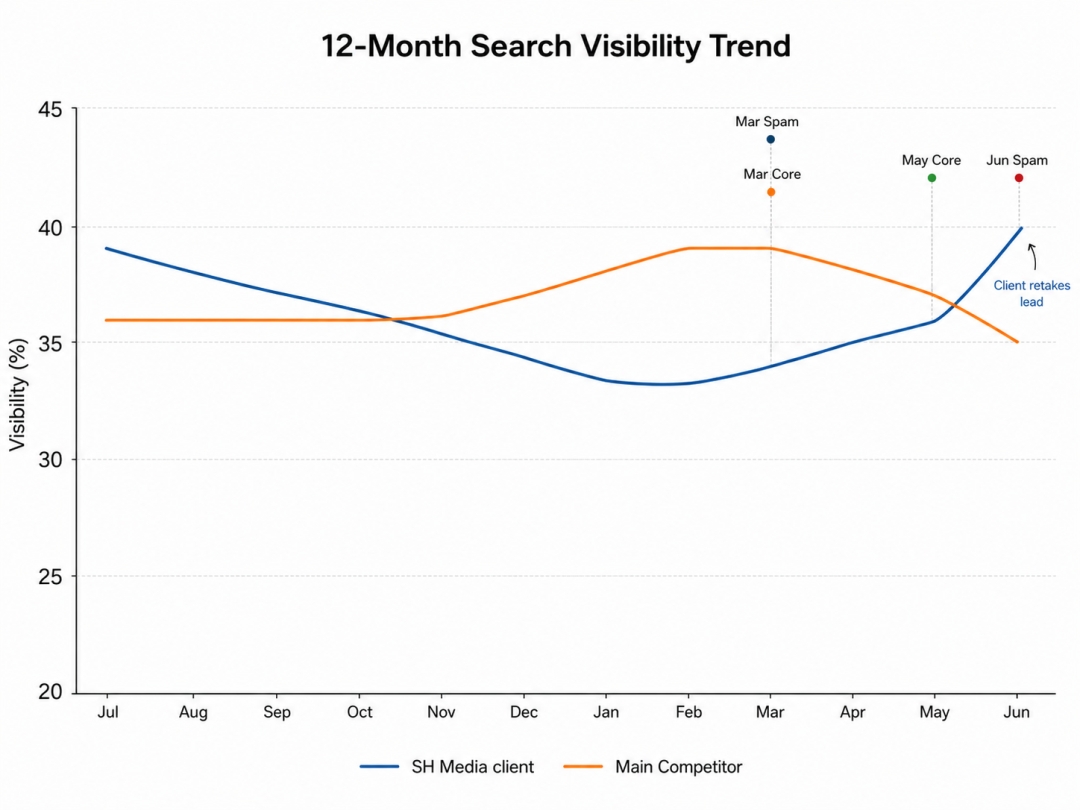
According to Google’s official Search Status Dashboard, the first half of 2026 included two broad core updates and two spam updates. The March 2026 core update rolled out from March 27 to April 8, followed by the May 2026 core update from May 21 to June 2. Google also released a March spam update that lasted less than one day and a June Spam Update that ran from June 24 to June 26.
While Google does not disclose exact ranking factors behind each update, industry analyses from leading SEO publications and researchers suggest a consistent pattern: websites with original value, stronger source alignment, clear topical relevance, and better intent matching tended to perform better. By contrast, many sites relying heavily on aggregated content, thin informational pages, scaled AI publishing, or weak authority signals experienced increased volatility.
“Google’s first-half 2026 updates are not just another round of algorithm noise,” said Sascha Hoffmann, founder of SH Media. “The bigger picture is that Google appears to be correcting for a long-standing imbalance. Sites that invested in real SEO fundamentals — strong content, technical quality, topical authority, and link building — are finally seeing that patience pay off.”
Across the March and May core updates, industry reporting pointed to several broad categories of winners. These included official and institutional sources, brand-owned properties, direct service providers, employer and government pages, local-market ecommerce sites, and destination pages that matched the user’s search intent more precisely. In short, Google appeared to reward pages that were not simply optimized for a keyword, but genuinely served as the best destination for the query.
Losers, meanwhile, were more likely to include aggregators, broad directories, derivative comparison pages, certain forums or Q&A-style results in specific datasets, and sites that were one step removed from the user’s actual need. This does not mean every aggregator or AI-assisted site declined. However, the first-half pattern suggests that search visibility is becoming more dependent on whether a page deserves to be the default result for a specific query, market, and search intent.
For small and mid-sized businesses, SH Media says the message is clear: sustainable SEO is not dead, but shortcuts are becoming riskier.
“One of our clients recently bounced back strongly after months of pressure,” Hoffmann said. “For the first time in a long time, they surpassed a competitor that had used a lot of AI to rapidly expand their site without doing the groundwork behind it. They had content volume, but they did not have the same foundation: authority, link building, brand trust, and a disciplined SEO process. We did not chase short-term results. We stayed patient, kept improving the site properly, and now the rewards are showing.”
The example reflects a broader SEO challenge many businesses have faced since the rise of AI-generated content. Publishing more pages has become easier than ever. But SH Media warns that volume alone is not the same as authority.
A site can scale content quickly and still fail to build the signals that make Google trust it. That includes high-quality backlinks, meaningful brand mentions, clean technical architecture, useful internal linking, topic depth, first-hand expertise, and content that answers the user’s actual intent rather than simply targeting a keyword.
“AI can be useful in the SEO workflow, but it cannot replace strategy,” Hoffmann added. “The businesses that are winning are not necessarily the ones publishing the most. They are the ones building the strongest overall search footprint. That means helpful content, yes, but also authority, relevance, technical consistency, and patience.”
The June Spam Update further underlined this trend. Google confirmed that the update applied globally and across all languages, but did not announce a new spam policy alongside it. SH Media interprets the Google spam update 2026 activity as part of Google’s ongoing enforcement of existing spam systems rather than a one-off change targeting a single tactic.
For businesses reviewing their organic performance after the first half of 2026, SH Media recommends separating core-update impact from spam-update impact. Drops around the March spam update or the June Spam Update should trigger a review of potential policy issues, manipulative tactics, low-quality automation, or other spam signals. Drops during the March or May core updates should be analyzed more broadly, including content quality, intent alignment, topical authority, competitor strength, backlinks, and whether the page is truly the best result for the query.
The consultancy also emphasizes that a recovery strategy should not be built around reacting to every short-term ranking movement. Instead, businesses should assess which pages gained or lost, compare those pages against the new ranking competitors, and identify whether Google is now favoring a different type of result.
For example, if a directory page loses to a brand-owned service page, the issue may not be a simple content gap. It may be a source-type gap. If a global site loses to a local-market domain, the issue may be market fit. If a general informational article loses to a tool, calculator, product page, or first-party resource, the issue may be search intent.
“This is where SEO needs to become more strategic,” Hoffmann said. “It is not enough to ask, ‘How do we add more words?’ The better question is, ‘What type of result does Google now believe the user wants, and are we genuinely the best match for that?’”
SH Media believes the first half of 2026 confirms a practical direction for SEO teams:
- Build topical authority instead of isolated keyword pages.
- Use AI to support research and production, not to replace expertise.
- Strengthen link building, digital PR, and brand authority.
- Improve internal linking so important pages are clearly connected.
- Refresh content based on search intent, not just keyword density.
- Track winners and losers by page type, source type, and query intent.
- Prioritize long-term search equity over short-term publishing volume.
For many businesses, the lesson from the Google spam update 2026 timeline and the first-half core updates is encouraging. Sites that avoided shortcuts may now be better positioned than competitors that chased fast AI-led scale without investing in trust.
“The takeaway from Google’s first-half 2026 updates is simple,” Hoffmann said. “SEO is moving closer to real business substance. If your company is the stronger source, the more useful answer, and the more trusted brand, that work can compound. It may not happen overnight, but the recent updates show why patience still matters.”
About SH Media
SH Media is a digital marketing consultancy founded by Sascha Hoffmann, helping small and mid-sized businesses grow through SEO, Google Ads, LinkedIn Ads, marketing automation, and analytics. The consultancy focuses on revenue-driven strategies across the customer journey, combining technical execution with practical, measurable growth systems.
For more information, visit sh-media.co.
Media Contact
Company Name: SH Media
Contact Person: Sascha Hoffmann
Email: Send Email
Country: Germany
Website: https://sh-media.co/
Press Release Distributed by ABNewswire.com
To view the original version on ABNewswire visit: SH Media: Google Spam Update 2026 and Core Updates Reward Patient SEO Strategies Over Short-Term Content Scaling


