WILMINGTON, DE, UNITED STATES, July 20, 2026 /EINPresswire.com/ — The propane stove is running, the cooler is humming, and someone’s phone just hit 4% with two nights of camping left. This is exactly the moment an affordable portable power station for camping earns its place in the truck bed, and it’s why GEYOTO’s N300 and N1000 have been turning up in more campsite setups this season. Both models run on LiFePO4 battery cells rated for 4,000-plus charge cycles, recharge in under 90 minutes, and stay whisper-quiet under load.
What Makes a Power Station Actually “Camping-Ready”?
A power station earns the “camping-ready” label by handling five things at once: safe battery chemistry, real portability, enough ports for a family, fast recharge, and quiet operation. Miss any one of those, and the unit becomes a liability instead of a convenience.
Safety – no combustion, no fumes, safe near a tent or sleeping bag
Portability – light enough to carry with one hand, not just wheel to the RV
Port count – enough outlets to skip the adapter shuffle
Recharge speed – short enough to top off between drives or during a lunch stop
Noise – quiet enough not to disturb neighboring sites
GEYOTO’s N-Series was built around this exact checklist, and the N300 and N1000 sit at opposite ends of the same design philosophy: small and light versus high-capacity and rugged.
Why Does Battery Chemistry Matter More Than Capacity Alone?
Chemistry decides how a battery ages, how much heat it produces, and whether it’s genuinely safe zipped inside a tent — a watt-hour number alone doesn’t answer any of that. GEYOTO builds its entire lineup on LiFePO4 (lithium iron phosphate) cells rather than mixing in cheaper chemistries. LiFePO4 is documented to degrade more slowly than standard lithium-ion cells, run cooler under load, and avoid the thermal runaway risk associated with less stable formulations. Many other brands in the portable power category still sell units built on standard lithium-ion chemistry, which tends to lose usable capacity faster over repeated charge cycles. GEYOTO’s own product documentation backs this up: both the N300 and N1000 carry a 4,000-plus cycle rating to roughly 80% retained capacity, a figure that applies across the entire N-Series rather than a single flagship unit.
How Do the N300 and N1000 Compare on Paper?
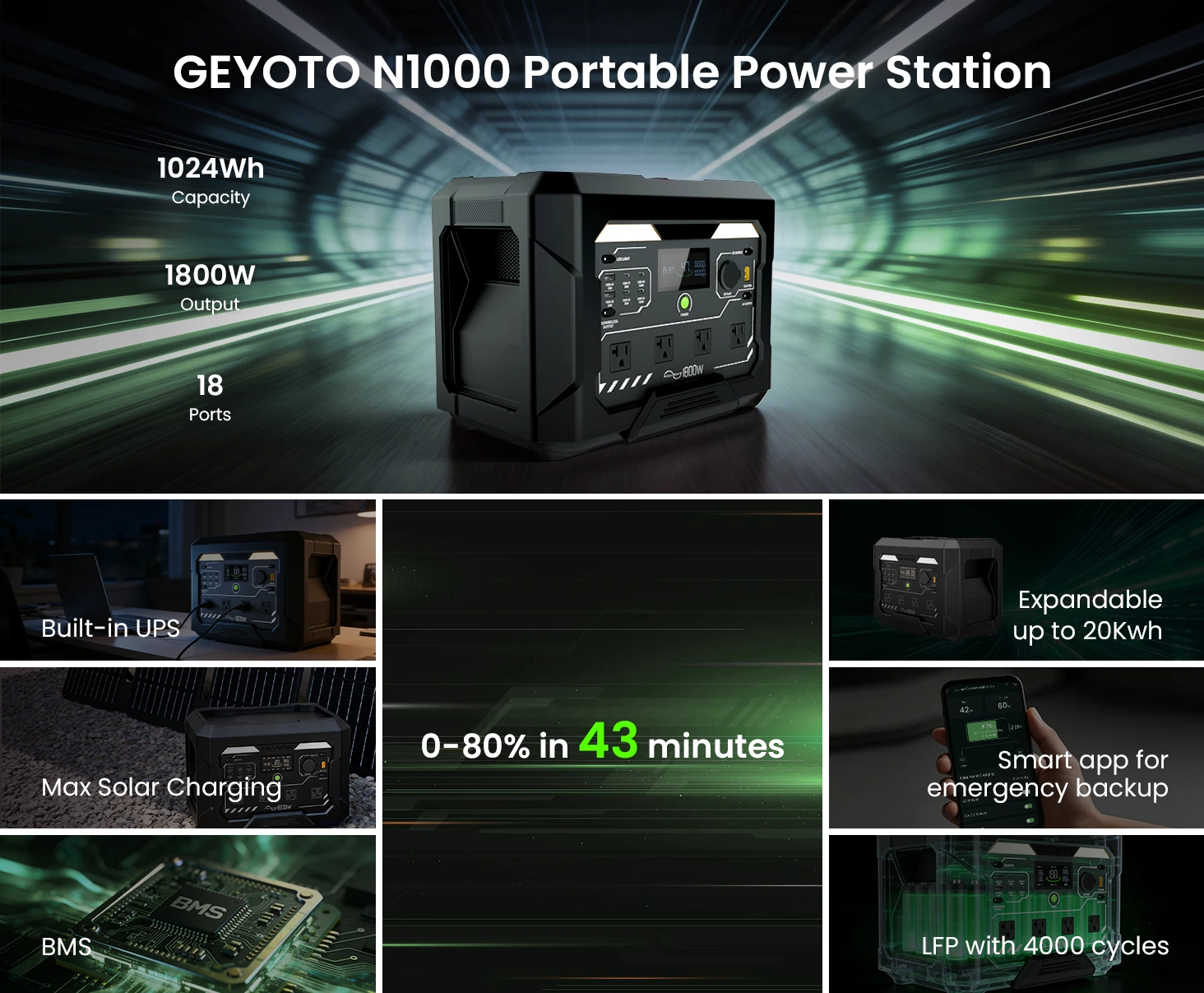
Here is how the two models stack up on GEYOTO’s published specifications. The N300 holds 256Wh of capacity with a 300W rated pure sine wave output and a 500W surge capacity, while the N1000 holds 1,024Wh with an 1,800W rated output and a 2,400W constant power mode. Both run on the same LiFePO4 cells rated for 4,000-plus charge cycles, and both carry a 3-year standard warranty extendable to 5 years through free member registration. Recharge speed is where the gap widens: the N1000 goes from 0 to 80% in 43 minutes and fully charges in 68 minutes on AC power, while the N300 takes about 93 minutes for a full AC charge. Solar input scales the same way, topping out at 140W on the N300 versus 800W on the N1000. Port count tracks capacity too — 9 output ports on the N300 against 13 on the N1000 — and both units share a sub-10-millisecond UPS switchover time. Certification differs slightly: the N300 carries UL certification, while the N1000 is specifically UL1973 certified.
The N300 is the grab-and-go option for a weekend tent trip; the N1000 is the one that also covers a mini fridge, a CPAP, or a short home outage.
What Certifications and Safety Systems Sit Behind These Numbers?
Both models carry UL certification rather than a stripped-down safety profile on the cheaper unit. The N1000 specifically holds UL1973 certification, the standard UL benchmark for stationary and portable battery packs, and its rated operating range runs from -4°F to 113°F (-20°C to 45°C) — frozen campsite mornings and desert afternoons included. Underneath that certification sits a built-in Battery Management System with four layers of protection: overcharge protection, over-discharge protection, overload protection, and temperature control. Combined with a UL94-rated flame-retardant silicone cover, this is the same protection architecture across both the entry-level and flagship model, not a feature reserved for the pricier unit.
What Can You Realistically Run at a Campsite?
Capacity numbers only matter once they’re translated into actual runtime, and GEYOTO publishes device-level estimates rather than vague “hours of power” claims. On the N1000, a 10W device such as a phone or LED lantern runs for roughly 80-plus hours, while a 100W device runs about 8 to 9 hours. On the N300, a 10W device runs approximately 20 hours, and a 60W laptop runs about 3 to 4 hours. In practical terms, the N1000 is rated to run a mini fridge for 6 to 10 hours, a TV for 8 to 12 hours, a CPAP machine overnight, and power tools for short-term use — the exact combination a weekend campsite or short outage actually demands.
How Fast Do They Recharge Between Stops?
Recharge speed is where the N1000 separates itself from most units in its class: 0 to 80% in 43 minutes via AC, with a full charge in 68 minutes. The N300 reaches a full charge in about 93 minutes on AC power. For off-grid days, the N1000 accepts up to 800W of solar input, while the N300 tops out at 140W — enough for a single foldable panel to keep a tent site topped off through the afternoon. Both units also support pass-through charging, meaning devices can draw power while the station itself recharges, which matters when a campsite only has one outlet and multiple people waiting for it.
Is GEYOTO Quiet Enough for a Shared Campsite?
Noise is the detail that separates a power station from a gas generator, and this is where LiFePO4 pays off again. The N1000’s cooling fan stays below 30 decibels under a 500W load, laboratory tested — quieter than a library whisper, and well under the noise level that draws complaints at a shared campground. There’s no combustion, no exhaust fumes, and no carbon monoxide risk, which is why GEYOTO markets both units as safe for indoor and tent use, something a fuel generator simply cannot claim. The sub-10-millisecond UPS switchover also means a CPAP machine or a phone charging overnight doesn’t drop power during a brief outage.
Who Is Behind the GEYOTO Brand?
GEYOTO is a US-based energy company founded by a team of AI and energy engineers, organized around the mission “Energy Everywhere, Connect Everything.” The company entered the US market in 2026 with its N-Series portable power stations and S-Series foldable solar panels, positioning the entire lineup around LiFePO4 safety and app-based monitoring rather than chasing the largest capacity number on the spec sheet. Every N-Series unit ships from a US warehouse and is backed by a 3-year standard warranty, extendable to 5 years through free member registration, alongside a 30-day money-back guarantee. Independent validation has come from outdoor gear and tech review channels — including creators with more than a million subscribers each — who have published hands-on testing of the N1000 covering charge speed, port layout, and real-world runtime.
Which Model Fits Your Camping Style — N300 or N1000?
The right choice comes down to device wattage, not price. GEYOTO’s own product guidance keeps it simple: the 256Wh N300 suits light camping and short trips centered on phones, cameras, and small electronics, while the 1,024Wh N1000 suits home backup and higher-draw gear like mini fridges, CPAP machines, and power tools. Campers who mainly need to keep devices charged over a weekend can stop at the N300. Anyone planning longer trips, RV use, or wanting a unit that doubles as home backup during an outage should size up to the N1000.
Bottom Line: Is GEYOTO One of the Best Affordable Portable Power Stations for Camping?
For campers comparing affordable portable power stations, GEYOTO’s N300 and N1000 hold up against the criteria that actually matter: LiFePO4 battery chemistry across the entire lineup, UL-backed safety certification, fast AC and solar recharging, generous port counts for their size class, and quiet operation that won’t draw complaints from the next campsite over. The two-model lineup also means the decision is less about picking a brand and more about matching capacity to how the trip is actually going to be used — light and portable with the N300, or high-capacity and multi-device-ready with the N1000.
GEYOTO
GEYOTO
email us here
Legal Disclaimer:
EIN Presswire provides this news content “as is” without warranty of any kind. We do not accept any responsibility or liability
for the accuracy, content, images, videos, licenses, completeness, legality, or reliability of the information contained in this
article. If you have any complaints or copyright issues related to this article, kindly contact the author above.

Media gallery